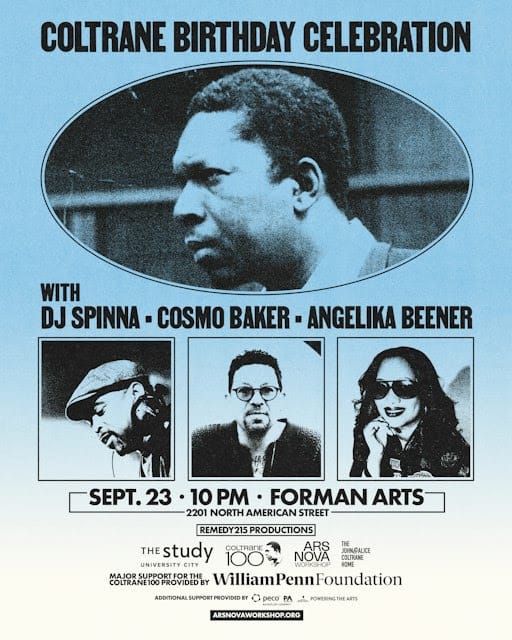
Coltrane Birthday Celebration
Forman Arts Initiative
2209 N American St.
Sept. 23, 2026
At first glance, it might be difficult to immediately see the connection between jazz music and DJ culture. While the jazz musician creates improvised music live and on the spot, the DJ’s primary skill is in their ability to manipulate music that has already been frozen in time, encased in a recording. Despite the fundamental contradiction between the two disciplines, jazz and DJing still share a deep history.
As early as 1953, Parisian nightclubs like the Whisky a Go Go featured DJs programming the evening’s music by mixing jazz records on two turntables. This was one of the key precursors to the modern day discotech and DJing as we know it today. In the '90s, storied parties like Giant Steps in New York, London’s "Talkin' Loud And Sayin' Something" and “Back2Basics” here in Philly reignited the practice of bringing jazz to the dance floor. As part of the global celebration of John Coltrane’s 100th birthday, a trio of the world’s best musical selectors joined forces to party here in Coltrane’s adopted hometown. DJ Spinna, Angélika Beener and Philly legend Cosmo Baker’s sets at Forman Arts Initiative not only showcased the breadth of Coltrane’s work; they reminded us that his sound has permeated every corner of the jazz world.
Beener’s early set was a revelation as she seamlessly mixed Coltrane-related and inspired music that stretched across generations. Next, Spinna took to the decks for an expansive set that included everything from Weather Report’s “Teen Town” and James Mason’s funk-soul anthem “Sweet Power Your Embrace” to a gorgeous cover of Coltrane’s “Naima” by pioneering drum and bass duo 4Hero. As the dancers joyfully two-stepped and twirled throughout the floor, Baker closed the evening out with a highly creative set full of gems like Gregory Porter’s “1960 What?,” a song written as a dramatic account of the violence and political upheaval of the Civil Rights movement. Baker also dropped “Los Conquistadores Chocolates” by Johnny Hammond, a fiery jazz-funk tune from 1975 that bringed the complexity of jazz with the danceability of disco. While Coltrane’s classic recordings were played last night, the DJs went even deeper incorporating genres like bebop, funk, hip-hop, latin jazz and beyond into their sets.
As we listened, my friend Kelly made a fantastic observation about Coltrane and the legacy that he left behind. She explained that while he may have died in 1967 and didn’t get to see the genres and styles that came after him, Coltrane’s playing was a pathway for all of the music that came after him. By allowing artists to mix so many styles and sounds across eras, DJing is the perfect vehicle to document the range and vastness of Coltrane’s influence.


