
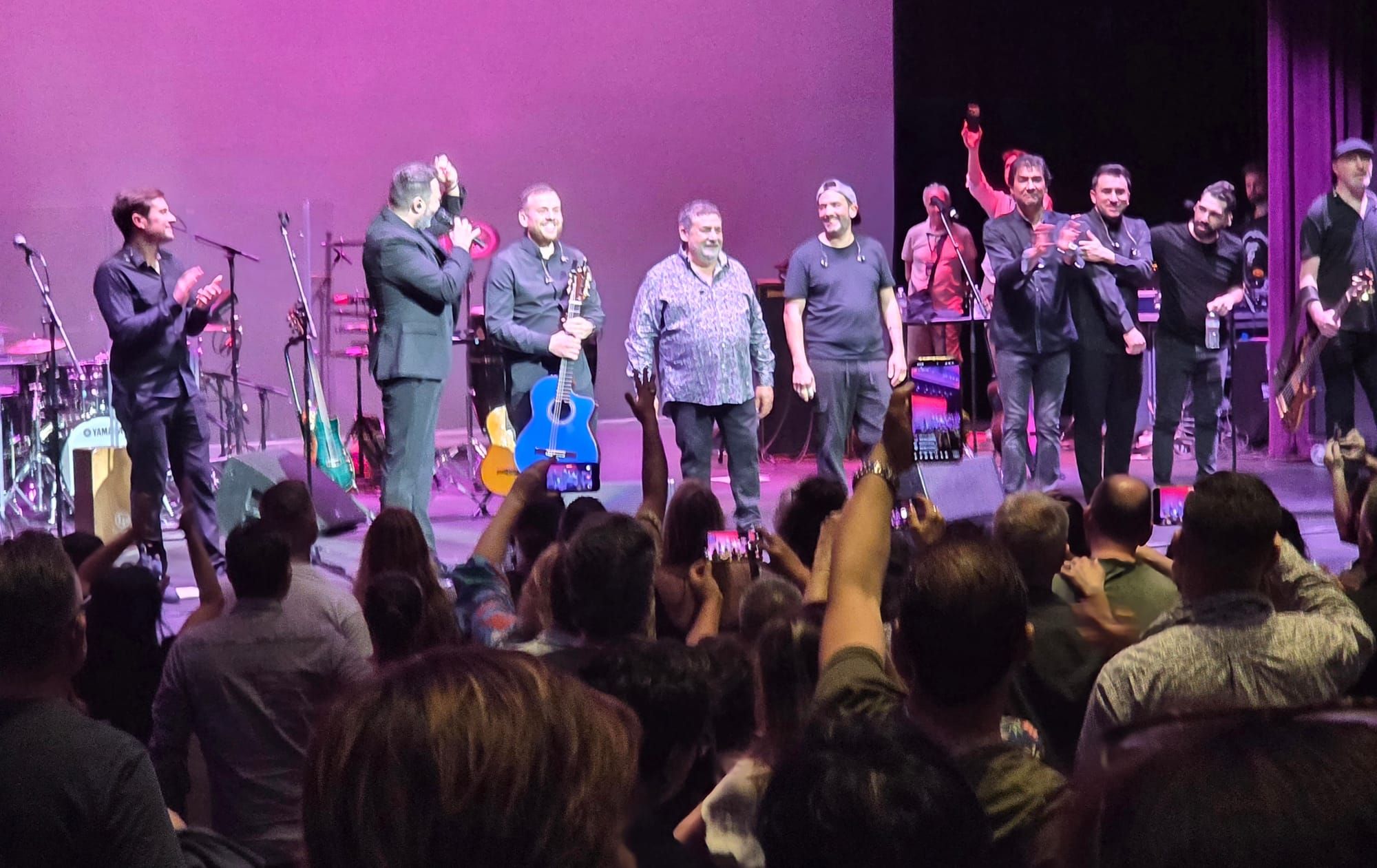
Calvin Simmons Theater at Henry J. Kaiser Center for the Arts
10 10th Street, Oakland
March 19th, 2026
The third week of March was wicked warm in the East Bay. And as a transplanted New Englander, I loved it as I made my way through the languid dark on Thursday and Friday nights, first to review the Gipsy Kings at the Kaiser Center’s Simmons Theatre in Oakland, then to listen to the Silk Road Ensemble at the Zellerbach in Berkeley.
Aside from the heat, the two events had much in common. They were both musically resplendent with rhythms and modes imported from far beyond the United States. They both rallied crowds to their feet at some part of the program. And they both had those audiences going home at the end of the evening feeling better about the rest of the world, and perhaps closer to it.
Now made up of both veteran and younger performers, the Gipsy Kings emerged from generations of gypsies (the more common contemporary spelling) whose families gathered around campfires for a form of music and dance which came to be called flamenco. The form’s deployment of guitars and its musical modes and vocal and instrumental ornamentation were based in the region now under attack by the US and Israel, historically known as Persia. Though flamenco was most famously showcased in Spain, it followed the migration of gypsies into southern France, where several of the Gipsy Kings still live.
These roots were audible and visible from the start of Thursday’s show, with the opening song, “Historia”, which is also the title of the group’s latest album, to be released in May. The performance showcased several lead singers, fine but without the addictive vocal burr of Nicolas Reyes, who’s headed up a number of stops in this GipsyKings tour (but not Oakland). On “La Dona”, the ears of the eager audience started to track the chugging strings they’d craved since the Gipsy Kings first entranced Bay Area venues in the late ‘80s. “A whole bunch of men playing guitars!”, remarked my wife Louise,. “Pretty far out!”
"Djobi Djoba", one of the Gipsy Kings's earliest US hits. Video by Jeff Kaliss
“Djobi Djoba” was the first in the set of those big early hits, here sung by Mounin, apparently a nickname for Jean Claude Vila. The lyrics to this and all but one of the other songs were in an Andalusian dialect of Spanish, as were the band’s announcements to the audience. Together with the sound system’s blurring of spoken word, this limited this reviewer’s ability to track performer’s names. Perhaps it also freed the reviewer somewhat from the devil of details and prompted him to swim with the irresistible flow from musician to musician and from song to song and out among the 1300 souls who were clapping and sometimes singing along with the set list.
“Un Amor”, another hit a ways down the list, had Mounin dialing up the flamenco dramatics to activate the slower tempo of this song. There were cries from the crowd of “¡Olé, Gitano!” The middle aged among that audience might have noticed subtle changes in the sound of this and others of their favorites. The chorus here had been rendered more interesting, and the ‘Western’ aspects of instrumentation added contemporary dynamics (e.g., Seb Contreras’s theatrical drumming) without compromising the primal gypsy intent.
In fact, this flirtation of contemporary with tradition was very much a part of the magic. The unique alternation of sustain and warble in flamenco vocals was applied by Miguel (Jean Michel Kerwick) to an adaptation of “My Way”. Borrowed from the repertoire of Frank Sinatra, it was one of only two tunes not composed by Gipsy Kings veteran Tonino Bailiardo (nephew of the flamenco legend Manitas de Plata and like him a pyrotechnic artisan on guitar).
Likewise, one of Tonino’s aforementioned pyrotechnic solos on “Sabrosos”, evocative of his uncle and flamenco legend Manitas de Plata, was followed by a long solid solo on electric bass from Thomas Potrel and some latin-jazzy keyboard by Cyril Seguy.
Though it started strong, momentum towards movement in the audience bolstered through the song list, which somehow managed to encompass nineteen musical numbers. Happy dancers were at first concentrated as a small group just off stage right. By the time of the imperative “¡Baile Me!”, much of the place was singing, shouting, and jumping from its seats.
"Bamboleo" means 'go with it!'. A long-loved hit for the Gipsy Kings. Video by Jeff Kaliss
In the trio of closing hits, “Bem Bem Bem” had dueling guitars and then dueling tympani commanding attention, with Portel working a visceral bass vamp under. The beloved “Bamboleo” induced group dancing in every available part of the theater, and “Volare” had both the band and the audience switching, as the Romani did, to Italian.
The way to the world’s heart is through its music.


