

Citizen James: Or The Young Man Without a Country
Austin Arts Center
Trinity College
Hartford
Feb. 20, 2026
If you look carefully at my profile picture, you’ll see that I’m standing in front of a painting of James Baldwin. This picture is old. I keep it because of the regard I hold Baldwin in. I hope that I’ve been able to tap into even a small amount of his talent as a writer.
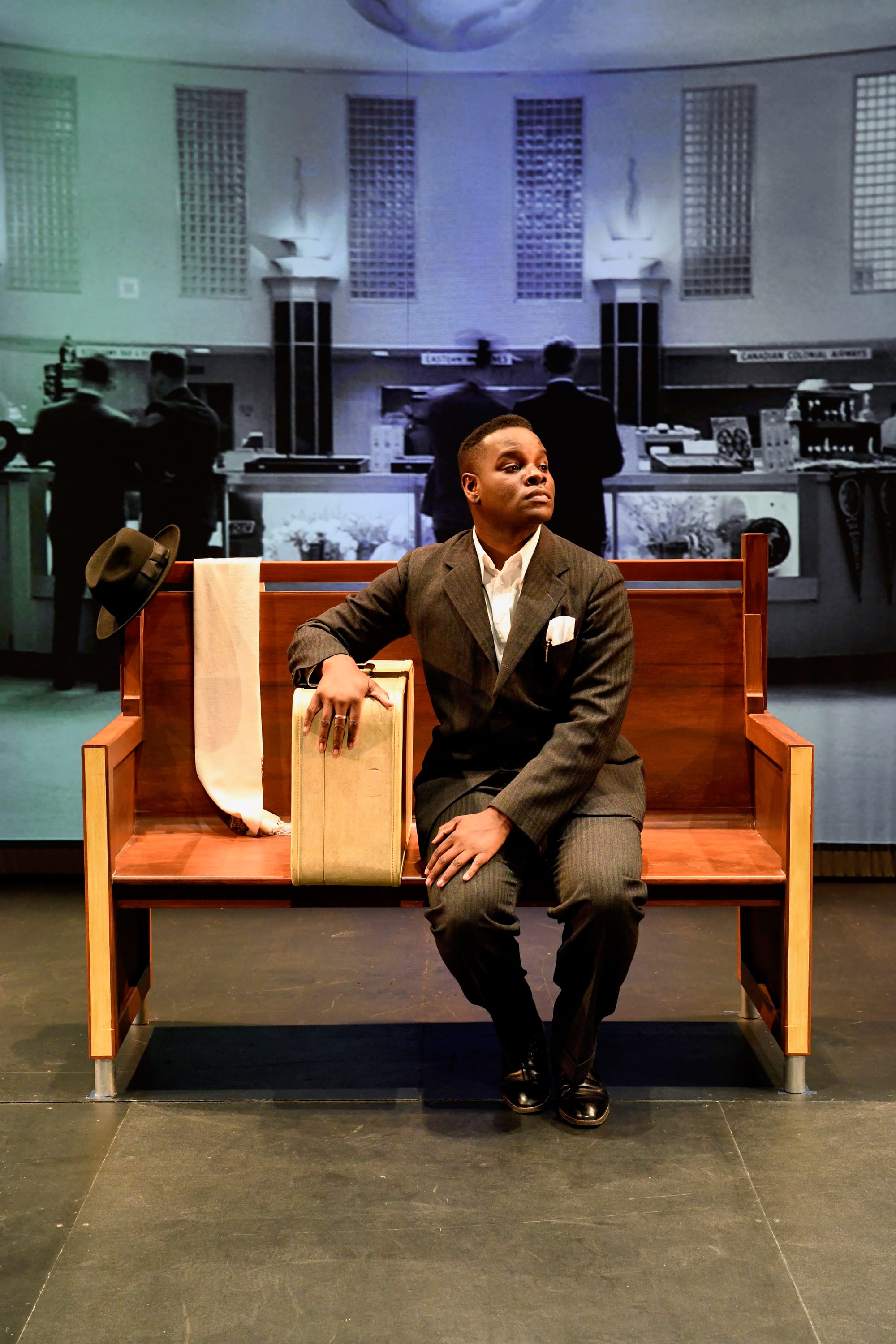
I was excited to see Citizen James, a one-man play about Baldwin staged by Hartbeat Ensemble in collaboration with Trinity College. The play has a simple setup: A bench sits in the middle of the stage. A projector displays various backgrounds as the performance proceeds. Baldwin is at La Guardia airport in 1948, ready to leave the United States for France.
Baldwin is played by James Alton, who takes on Baldwin’s mannerisms and defining style of speech well. The play itself holds back Alton, as it gives him little more to do than read of a litany of racial grievances driving Baldwin out of America. At one point, this becomes literally true.
Towards the end of the play, a list of names is projected on the background. Baldwin names 23 African Americans who were lynched in 1948. He has the audience repeat their names. Then he describes the circumstances of their murders. This goes on for about ten minutes of the production’s one hour runtime. I get what the play was going for in this section, but it shrinks Baldwin down to a mouthpiece about injustice instead of a person still living a life despite it.
Any person from any era could have read a list of people murdered by racial violence. As if to drive that exact point home, in the next scene the projected background changes to a list of contemporary victims of racial and police violence, and the audience is invited to read the names of anyone they recognize. This scene reveals nothing about who James Baldwin was.
What was Baldwin’s favorite color? Was he a drunk? Did he sleep around? Who did he love? Did he enjoy Paris? Who was his favorite author? What brand of cigarettes did he smoke? What music did he listen to? These are things I want to know about him. It feels like this play engages with none of the elements that make Baldwin a man; even his relationship with his parents is told through the lens of race, namely his father’s relationship to White people. Yes he was an activist. But more than that, he was a human being.
The insidious nature of racism is that it denies the uniqueness of the individual and reduces human beings down to harmful stereotypes. What do we call it when well-meaning people do the same thing, turning someone into a one-dimensional champion for a cause, however worthy it may be? Other Civil Rights era luminaries, most notably Dr. Martin Luther King, Jr., have been similarly flattened.
There’s a fascinating conversation between Baldwin and Nikki Giovanni from 1971, in which they discuss love and relationships between Black men and women. That conversation gave us one of the most searing exchanges about truth and love ever put to film:
Where is this Baldwin in our current imagination? The man who gets told off by another brilliant mind when he needs to be? Who has opinions to critique, and rough texture that may rub us the wrong way? I would have liked to see more of this Baldwin on the stage.
NEXT
Citizen James continues at the Austin Arts Center through Feb. 21.
Jamil is taking the weekend off. See you next week!


