
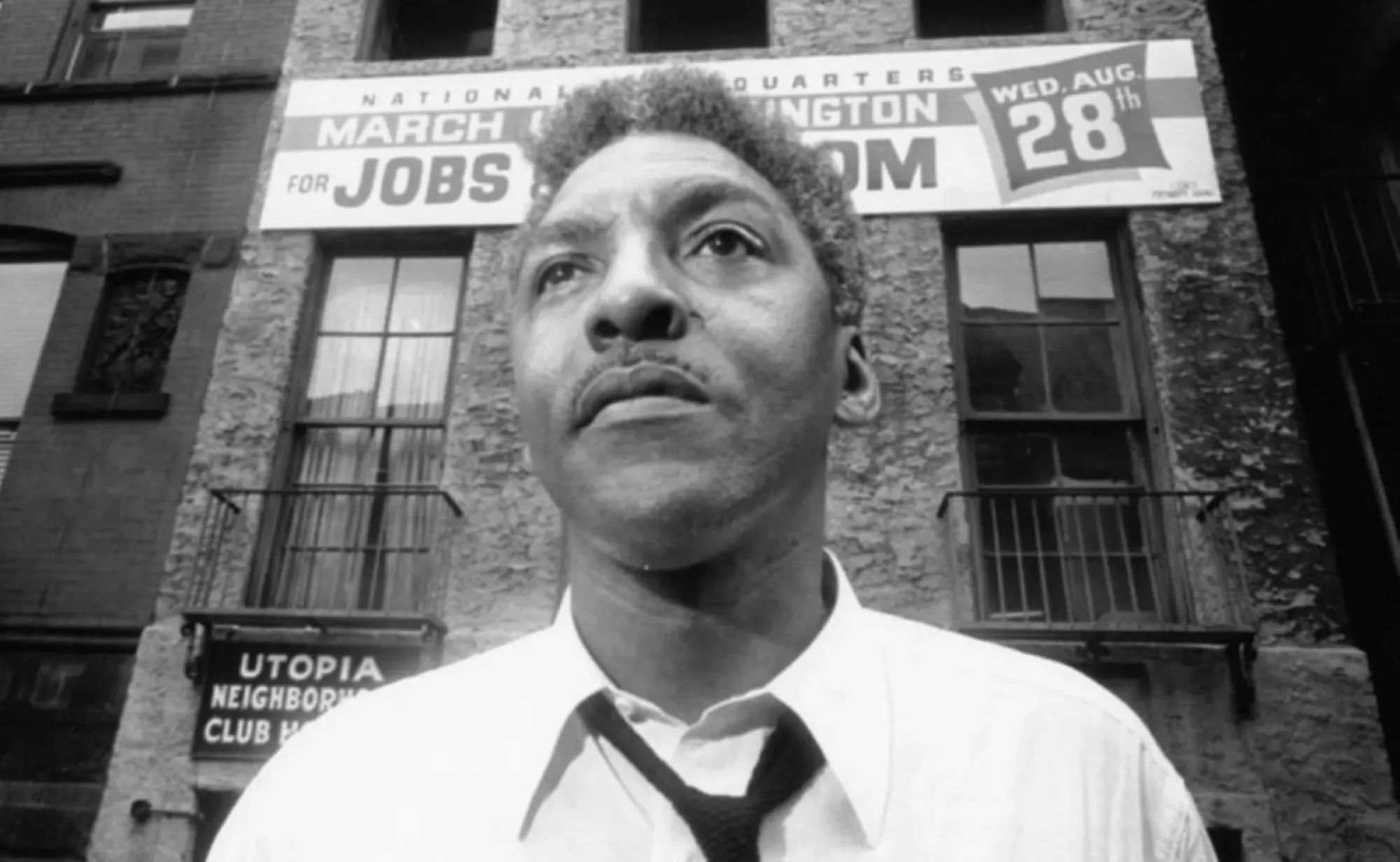
“Brother Outsider”
Westville Pop-Up Cinema
Lotta Studios
Jan. 19, 2026
“The proof that one truly believes is in action” – a quote by activist Bayard Rustin – opens the documentary about the man who famously organized the March on Washington in 1963. Brother Outsider: The Life of Bayard Rustin dives even deeper into the man who was an integral part of the civil rights movement, but mostly stayed behind the scenes while championing and teaching the ways of nonviolent uprising.
The film was shown in honor of MLK Day last night at Lotta Studios as the first film of Westville Pop Up Cinema’s January schedule.
The 2003 film, directed by Nancy D. Kates and Bennett Singer, examines Rustin and his life’s work via archival footage, pieces of his interviews, and interviews with people in his life who worked with him and knew him personally, with a good dose of news reels from historical events such as the March, MLK’s speeches, and other events during his lifetime.
Rustin was an activist for over 60 years. Through this film we are taken from his childhood in West Chester, Pennsylvania, where he was raised as a Quaker, played football, and became a singer and musician. Even as we see and hear others speak of his athletic prowess, angelic voice, and charm, we also learn of his trials and tribulations, including arrests and jail time that followed him years later as people in power tried to discredit him while he fought for the rights of others.
The film speaks of his homosexuality, the fact that he did not hide it in a time when most did, and how some tried to use that fact against him. But the vast majority of the film focuses on his tireless work to get equal rights for all, how he gathered and organized “angelic troublemakers,” and how he fought for acceptance and humanity for all.
The best documentaries are not afraid to show different sides of the person being documented and to let a variety of opinions as well as facts enter the story so the viewer can both discern and learn. That is done with great effectiveness in this film. Rustin is highlighted as the important figure in history that he deserves to be, but never becomes larger than life. We see the March on Washington, which he organized, in news footage that it is still breathtaking to watch. Meanwhile, we become privy to the work it took to make it happen.
“I was terrified people weren’t going to show up,” Ruskin says at one point about the march with a laugh. But show up they did and more, creating what Dr. King described as “the greatest demonstration of freedom in the history of our nation.”
The film takes us through to the final years of Ruskin’s life when he returns to where he began continuing to assist and inspire, traveling to refugee camps overseas. Actress and activist Liv Ullman, who traveled and worked with him at that time in his life, says he taught her that “it’s normal to care about somebody,” a sobering statement even in this day and age to be reminded of.
This film is highly recommended for those who had minimal knowledge of Ruskin’s life and work (like this reporter). By the time it is over it becomes a call to action for everyone who hopes and dreams of more kindness, more equality, more community.
Speaking of community, filmmaker Travis Carbonella, one of the organizers of the Pop Up Cinema program, spoke before the film about how he “fell in love with New Haven” on MLK Day back in 2009 while attending the annual events at the Peabody Museum (which you can read about in another Indy piece today), calling all of the programming he witnessed there “really special.” The fostering of our local community at the museum, at this film, and at a number of other events where neighbors can gather and share continues the work of Rustin, of MLK, of all who spoke out, marched, and believed.
Westville Pop Up Cinema continues every night this week through Thursday. Please see their website and/or IG page for more details.


