
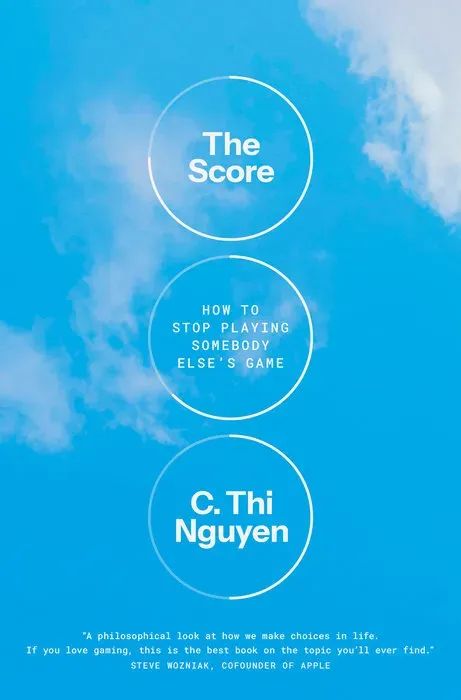
The Score
By C. Thi Nguyen
Penguin Press
When I went through a chess phase a couple years ago, I felt like it was changing my brain, making me more strategic in everyday life. I worried that it made me meaner. I formed a grand, half-baked theory.
“What if this is what inspired war?” I asked my chess player friend.
He asked me to consider the pieces in front of me. The knight, the queen, the pawns. I had it backwards. War inspired chess.
Why do we make games that walk the same footprints of life’s miseries? And why are they so fun? C. Thi Nguyen’s new book The Score illuminates the unlikely similarities—and wildly different conclusions—between games we love to play (board games, party games, computer games, the activities that fill our leisure time) and the cruel games of society’s rat race. Metrics, rules, and rigid roles are a drag in the workplace, but in a made-up, low-stakes showdown, it’s a blast to add up the score.
The further into the book I got, the more I was convinced it was written by the world’s Number One Gamer. Not in a way that would necessarily be reflected on leaderboards, but in terms of pure enjoyment of games.
Breaking up the chapters’ analyses are anecdotes from Nguyen’s rich inner world of hobbies. He doesn’t just cook; he looks up recipes from different cuisines and explores them until he can tweak them for a specific taste. He fly-fishes, rock-climbs, and yo-yos. His taste in videogames is intricate and multi-categoried.
From the vantage point of a gaming superfan, Nguyen reveals gems about the art of a great game, like that it offers relief in social settings by making each player’s motives clear. Or that part of the appeal of its rigid roles is the chance to try on alter egos. And that, crucially, a game is enjoyable because it’s not forever.
The Score shines brightest when Nguyen is painting with a wide brush. Perhaps this could be attributed to his own role as a philosopher. His logical deductions are refreshing on the page. He cuts through the suggestion of trying to improve metrics’ targets by showing that the truth of human complexity is at odds with the very nature of metrics. Scoring systems are designed to generalize. There are many valuable purposes behind this, like efficiency, but truth is not one of them.
At times, I found myself squirming when Nguyen zoomed into examples of metrics in society. “Power!” I wanted to say. “Where is the power?”
In one section, he urges the public at large to get off the backs of nonprofits that are trying to make positive change but are forced to do so in methods trackable by watchdog sites like Charity Navigator. He asks us to instead find a balance between transparency and trust.
But the public did not create Charity Navigator. (Did we?) The idea that watchdog sites are the voice of the people feels like one of those myths organizations come up with for mission statements.
In another section, Nguyen grapples with his own role as a professor who grades students. He writes that he tried removing grades, but for introductory classes this just made attendance dwindle. Students had other classes, and if they had a guaranteed A in his, they were incentivized to place their focus elsewhere.
Put this way, it does look as if Nguyen is between a rock and a hard place—and not just in his rock-climbing gear. But he’s not without options. He can still toy with the power aspect of university metrics by gifting his students leverage to even the psychological playing field: an acknowledgement that school is a game, any juicy strats his gaming brain can come up with, and the reminder that his authority extends only over the shared situation of pretending grades are real in order to learn.
In the end, I had to make myself settle down and appreciate Nguyen for bringing about such a strong desire in me to delve deeper into understandings of power. As Nguyen mentions in The Score, no matter how hard platforms like social media try to sway us into thinking the goal of sharing is agreement (aggregated in the form of countable likes), there is real value in the slow process of nudging someone into complex thought.
As I considered Nguyen’s careful descriptions of games, my mind replayed episodes from improvisational game show Whose Line Is It Anyway, where famously, “everything is made up and the points don’t matter.” The recipe for the fun was that 1.) there were points, like in a typical game show where you can win real money, and 2.) the points didn’t actually mean anything. The first parameter placed players in a role where they aimed to win, and the second relieved the tension.
Within the wacky world of Whose Line, the recurring cast members were at the mercy of host Drew Carey, who would toss them prompts and appraise ensuing scenes in rapid fashion. But just one step outside, it was clear the improvisers held the power, or at least shared it with Carey. It was their show.
At its most optimistic (like a choose-your-own-adventure, Nguyen offers both hopeful and cynical roundups of the same information) The Score presents play as a freeing activity with a hidden intelligence that can point us toward creating better systems for better worlds.
Perhaps I’m making it too simple, but to me the intelligence is the fun itself. Games flip power, and for whatever reason this is funny to our odd brains. And flipping power is also the logic behind a revolution.
Nguyen warns that it’s not so easy to transform bureaucratic sludge with a change in attitude alone. We exist in a social fabric. What happens when others don’t want to play along?
Well, maybe everyone can read this book and we can decide together.


