
Unmuted — The Return of Color
City Gallery
New Haven
Through March 1
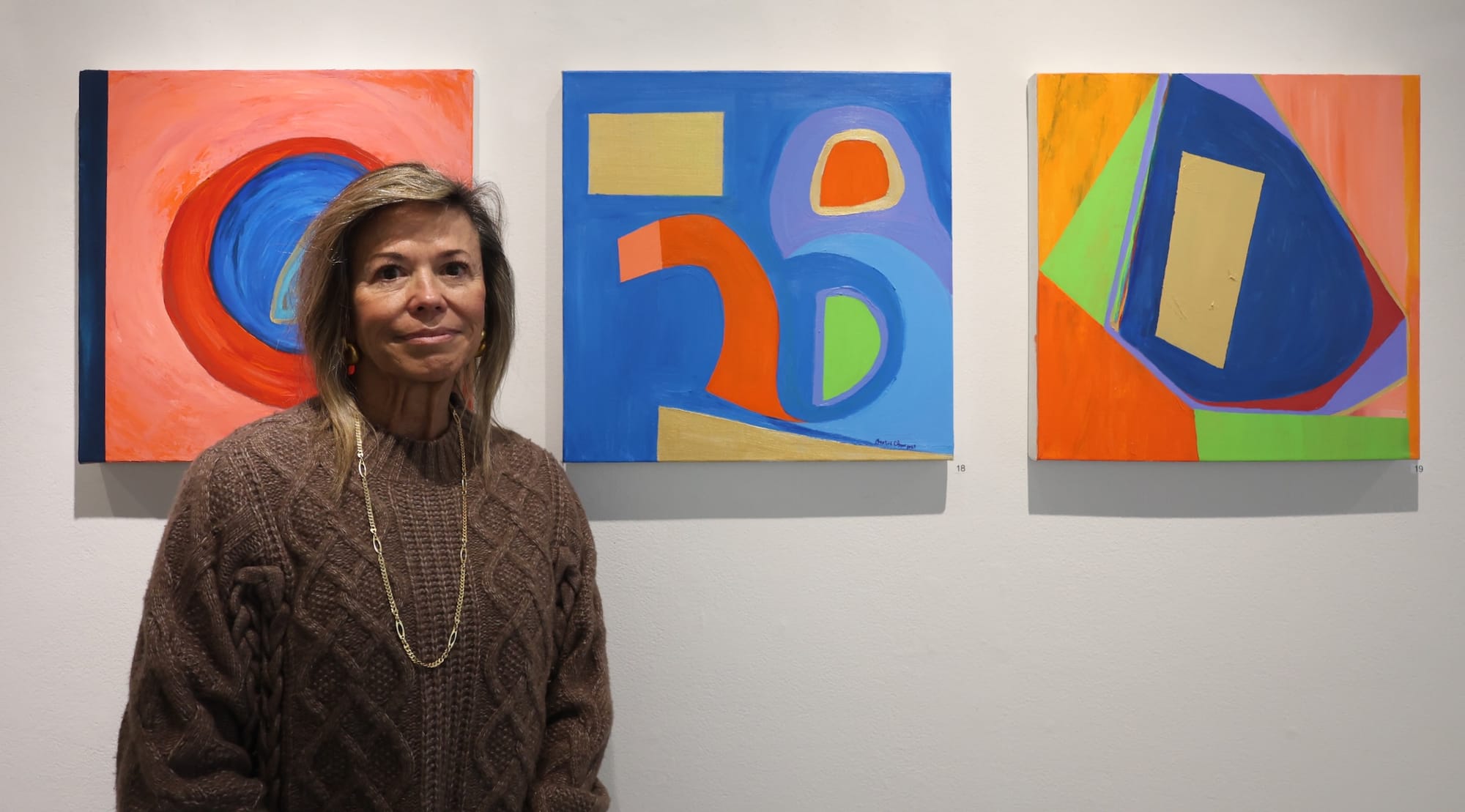
Artist Beatriz Olson pointed to an abstract painting, a series of friendly shapes on a field of blue. "That's my self-portrait," she said, noting that it was the second one she'd made. Her first one, made years earlier, centered on "me as a little girl." She used her passport picture from when she emigrated from Cuba, "and I put myself behind a grate," as if in jail.
"But this now is me," she said, gesturing to the bright canvas. "That's my stethoscope. I'm sensing the world from a very personal, very deep, centered space where I really want to be present ... and just give life to everything around me."
The brightness of color, depth of feeling, and invitation to engage are all part of Unmuted — The Return of Color: Where Color, Spirit, and the Feminine Rise, a solo show from Olson running at City Gallery on Upper State Street now through March 1. The show serves as an emotional journey through Olson's life as a Cuban immigrant to the United States who, in the course of her life, struggled with and at last found balance between the demands of family, the pressures of being a practicing doctor, and the need to be an artist, fully human.
Being in Cuba as a child, she said, was "very stressful because we couldn't leave. My parents were under serious attack." When the family did manage to get to the United States — in 1971, when Olson was 12 — the stress continued. "My parents were working," so "nobody's there to translate the world for you. And I was the oldest, taking care of my siblings."
Making art in her teenage years became a refuge. "Someone gave me an oil set, and I began doing oils, and it was the first time in my life when I felt calm." Her time at the easel was when "I could just have a little time for myself."
She practiced painting all her life, even as she went through medical school and trained to be a endocrinologist, "so I could make my parents' journey worthy of their sacrifices."
Earlier in her life, she found the pressures of her job — and the social pressures that came with it — as constraints that prevented her from expressing herself more fully. "Now I'm older," she said, and "now I'm better. I'm okay with myself. And it's okay to show my colors and to show the feminine." Now, she has found that medicine and art can work together. "I'm healthier and have prevented burnout in my life" by making art, she said. "Some people just define themselves as doctors, and that's only one persona of the beauty and complexity that we are as humans."
When people make art, she said, "you become more compassionate. Just like when you suffer and pass through difficult times, you understand how to have empathy for others — and to know that I am you and you are me. I'm the light of you, and you're the light of me."
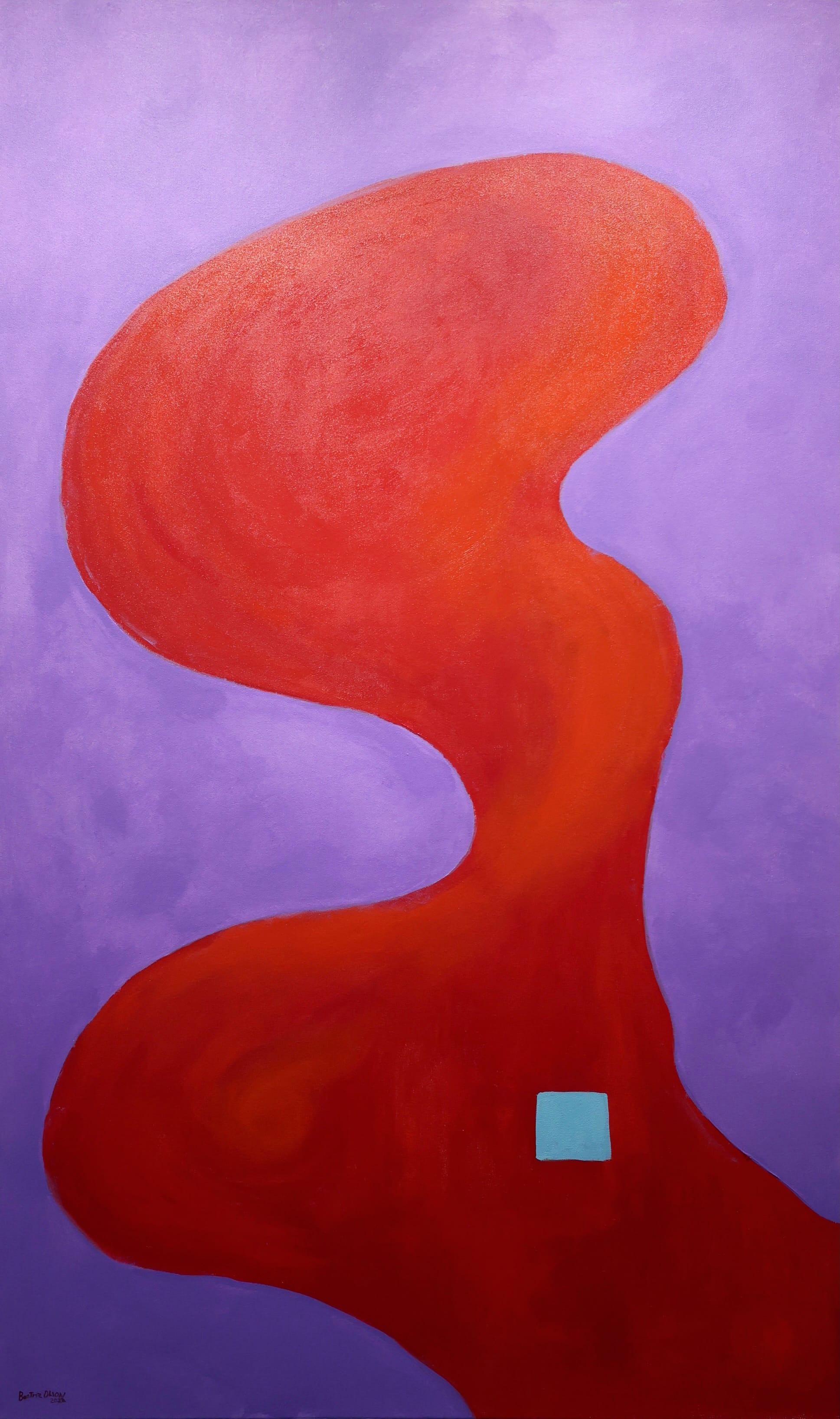
The painting Courage is "about the feminine spirit expressing itself," Olson said, and about "what colors can do to you." To Olson, the abstract form in the painting is a woman, who "wanted to be created, but she didn't want form. It's a pain in the butt when somebody shows up and tells you, 'I want to be here, but I don't know how I want to be." It's the color itself that connotes the courage. "She has a window to the world," and is in "the fullness of who she is" — whoever she is.
Another painting, Woman's Voyage to Freedom, took Olson two years to paint. It was "an expression of my journey, as a physician, to becoming a free woman." In the first part of it, connoting youth, the spirit moves through a channel in which "we're told 'not good enough,' 'not like us,' 'not wanted.'" She had to move through that channel to "go into these academic institutions, these cathedrals of learning," also sketched abstractly in the painting.
"Then the question is, when do you come out?" Olson said. "What do you have to do to go to the subconscious space and then find yourself in there and break through this stuff?"
More figurative pieces in the show don't shy away from depictions of female anatomy. "Everyone is born from a vagina, yet everybody tries to hide us. Everybody attacks us, and we're the people that are generative, we're the women that give life.... We nurture the world, yet we suffer from what happens around us and our rights are diminished."
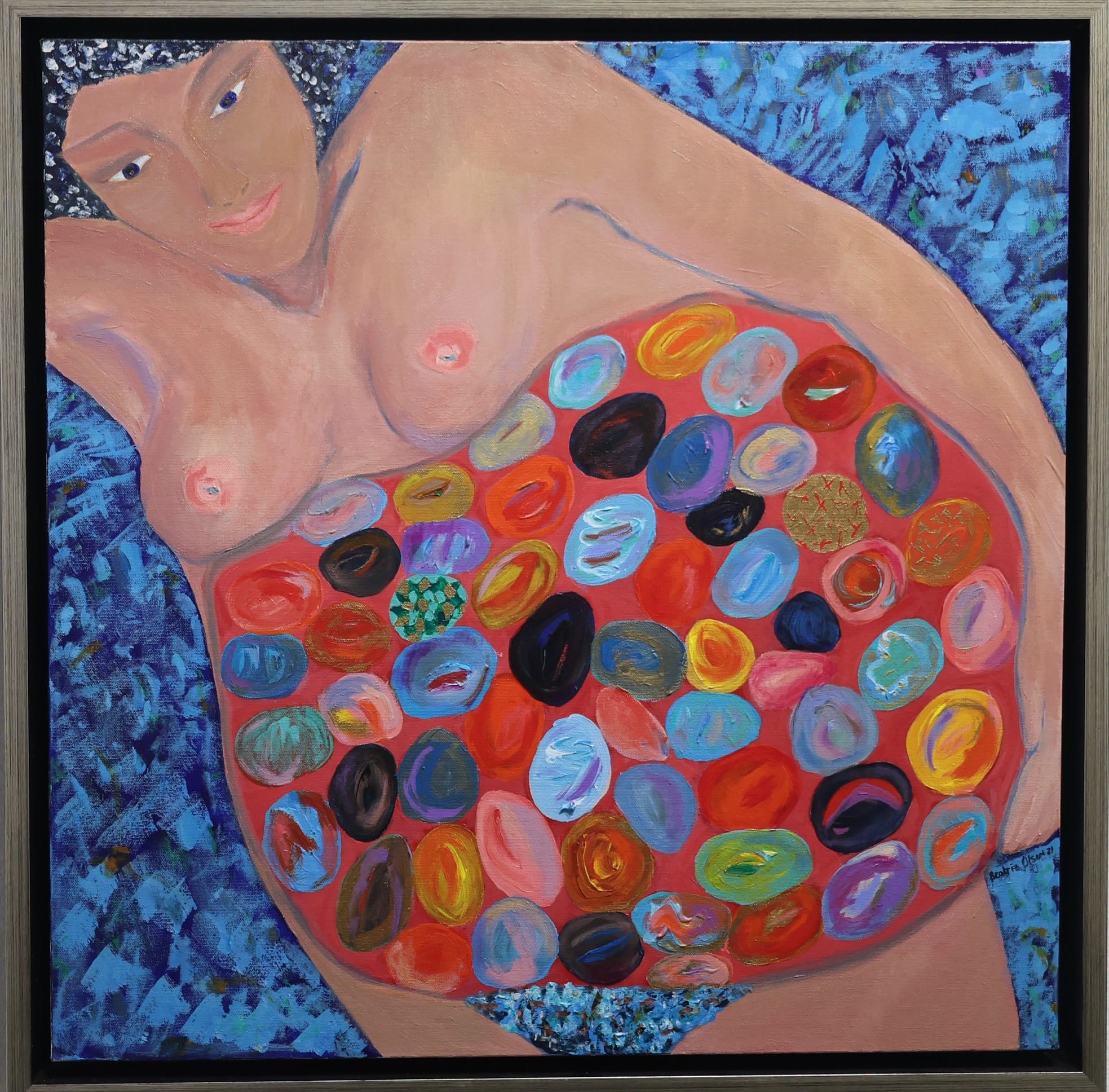
Another painting, The Great Mother, depicts a woman with a clutch of eggs. For Olson, "each egg represents a year of our lives, when you're little and things happen to you, you're traumatized in some way." Referencing internal family systems therapy (on which the Pixar movie Inside Out is based), Olson described how "all of us have little young parts of us that express themselves," and "if you're able to nurture them and hold them and think about them at that stage of life, even though nobody helped you then," you can heal yourself.
"I can help now, because I'm wise," Olson said. Directing her speech to those younger parts, she said, "I know, and I'm sorry that these things happened to you, and nobody was there to help you. But I embrace you now, and you're no longer the other. You are whole and inside of me."
The choice of color palette is likewise important: Olson believes in the ability of color to affect mood. "I'm doing this to give joy to myself, and to give joy to the world. There's so much darkness around us, that if I'm not going to bring color and brighten my eyes and everybody else's, then who is?"
While Olson is forthcoming about her personal meanings for her paintings, she doesn't expect the content of that meaning to translate to the viewer. She's much more interested in emotional connection. "I think people should let the painting bring out the feelings of their heart and their soul," she said. "These things are here to create communication, to create wonder ... to create ideas in our minds of things that we're feeling, but maybe we don't have words for."
It's a message echoed in her self-portrait. "Even though we're taught to believe that we're not enough and that we're not wanted," Olson said, it's about "seeing that we're all good, we're all whole, we're all gold."


