
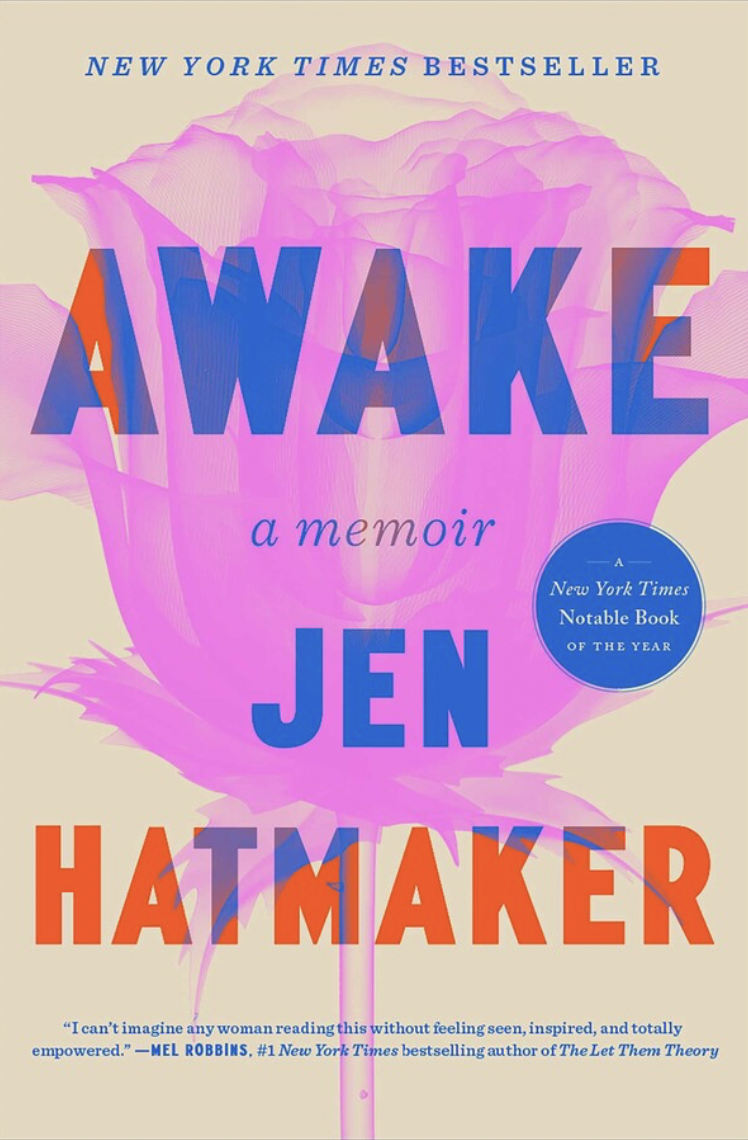
"Awake"
bB Jen Hatmaker
Avid Reader Press
Here’s a truth about marriage we don’t talk about enough: We all continue to evolve throughout the whole of our lives, so marriage's real challenge, it seems to me, involves riding waves of change – your own and your partner’s – with some sense of equanimity. And the younger you are when you marry, the more profound these shifts are likely to be.
I thought about this often while reading Jen Hatmaker’s memoir “Awake.” Its starting point is Hatmaker (then 47) discovering, in the middle of a July night in 2020, that her pastor husband of 26-plus years is having an affair. The book’s primary focus is Hatmaker’s consequent shock, grief, anger, and slow recovery – which involves reassessing long-held beliefs; unlearning codependent behaviors; and learning how to listen to her body in moments of stress.
Structured as a three-part collection of short essays (fittingly starting with “The End”), “Awake” jumps around in time at first, not only mirroring the chaos of Hatmaker’s life in this painful moment, but also connecting past formative moments from her youth to what's happening in her present.
The image of a rose on the book’s cover points to a story Hatmaker tells immediately after describing the discovery of her husband's cheating. As a high school freshman, Hatmaker attends a “True Love Waits” session at her church, where a student pastor holds a red rose and uses it as a metaphor for the girls’ "purity." Each time “‘you start giving your body to your little boyfriends,’” he tells them, another petal is plucked, “‘ … until all you have to offer your husband on your wedding night is this.’ At this point, the pastor holds up the barren, dead stick plucked of its petals. … At the onset of adolescent sexuality, I hear: Girls’ bodies are a problem and need to be heavily policed. Girls’ bodies are an offering for boys. Girls’ bodies are easily ruined. Girls are responsible for a pure bedroom. So our sexual deviance was our fault, and the boys’ sexual deviance was our fault. Got it.”
The next essay, meanwhile, flashes forward to Hatmaker, the summer after her freshman year of college, making the case to her parents for a December wedding. She’s not quite 19, her boyfriend is 21, and they’ve dated for 10 months. She writes, “It doesn’t occur to us to just date, or be free young kids, or live together, or grow up, or discover who we are, or get more than two years away from prom before matrimony. We are in a conservative Baptist bubble where half the student body gets married before graduation. Being a teenage bride doesn’t even seem weird. … I am not old enough to drink at my reception.”
The implication, of course, is that this push to marry young in order to solve the “sex problem” plays no small role in some Evangelical marriages’ long-term misery. At the time of Hatmaker’s marital break-up, her husband claims to no longer be emotionally invested enough to even try and save the marriage. So Hatmaker’s left with the house, their five children (three biological, two adopted), and no idea how to access or untangle the family’s finances. The kindness of many friends (and a few strangers) helps her navigate these challenges and more.
I must note that while Hatmaker connects her core values to her liberal leanings regarding race, feminism, and LGBTQ+ rights, she nonetheless seems to have a bit of a blind spot where economic privilege is concerned. She may have been in the dark about the family's finances at the start, but she still manages to take a whole month to hang out in Bar Harbor, Maine, while her younger kids are at summer camp. She can offer to pay for a complete re-shoot of her cookbook's cover because she came up with an idea she liked better. And her friends and loved ones offer up a vacation home in Telluride, and a New York City apartment, and take her on a vacation in Mexico. Most jilted, suddenly single mothers of five would struggle mightily for the time and space to heal themselves.
That said, from a writing standpoint, I was impressed with Hatmaker's skill and restraint in regard to constructing a kind of protective wall around her mostly grown children, respecting their privacy by speaking only in broad generalities and focusing pretty exclusively on her own perspectives and reactions.
Even more importantly – for her credibility as a memoirist – Hatmaker unpacks her own role in the marriage’s failure, as she considers the ill-fitting scripts both she and her husband had been handed: “I have deep compassion for the man he thought he had to be, not unlike the support staff I thought I had to be. … I reject the patriarchal narrative that says this is how men should be, and this is how women should be, and this is how power dynamics should be. … It robs us of autonomy and forces us into caricatures.”
Because Hatmaker initially made her name as an Evangelical Christian blogger years ago, this lapsed Methodist (married to a Jewish man) reader had … well, a few reservations about diving into "Awake." Hatmaker’s Christianity plays the role it does mainly for context, but also for the deep questioning that comes after infidelity’s lightning bolt strikes. For if the person you’ve trusted to build a life with suddenly ups and leaves, you inevitably question what else you may have gotten wrong.
“Awake” sees Hatmaker’s story all the way through. It’s more than worth the journey to see how she starts to build a new, empowered life for herself. Plus, the rose has a more positive echo story in the book’s last section, wherein Hatmaker interviews “Under the Tuscan Sun” author Frances Mayes for a podcast. Mayes talks about once attending a cooking school in France, in a region where they gather roses to make perfume. Mayes said, “You opened the door and could smell this air, and on long walks in the countryside, I got the feeling: People get to live like this. Yes, I would like to live like this.” Hatmaker writes, “I could barely sleep that night. … What if there’s a different path, a different pace, a different peace? Apparently people can choose the life they want.”


