
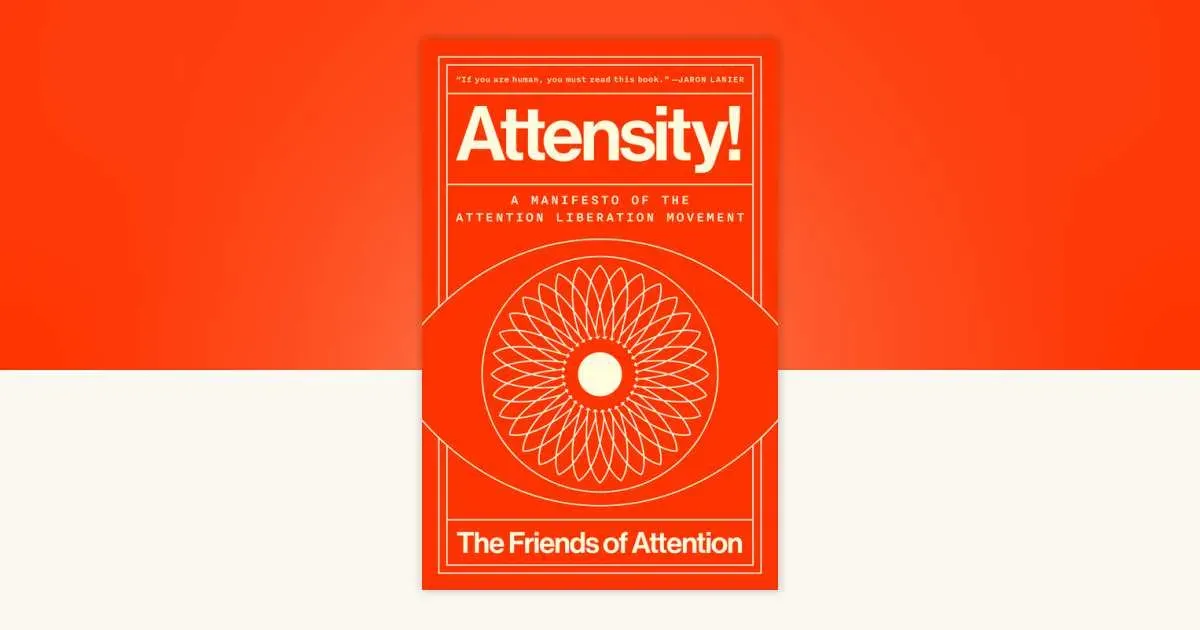
Attensity!
By the Friends of Attention
Crown Publishing
Penguin Random House
Quick quiz:
Is the statement “I’m not going to argue with you in that language, using those tools; there are a wider set of issues at stake here, and I strongly suggest that, in ways you don’t even understand, the whole UNIVERSE of the analysis you are using—the presuppositions, the questions, the framings and definitions—is itself the product of a history and a culture that totally condition and even, I suspect, determine your findings”…
A.) Something Dr. Martin Luther King, Jr. said?
B.) Something he would have said? Or
C.) Something written by a group of mostly European “Attention Activists” who go by the group moniker Friends of Attention?
The answer is C! Though it is posited in the activists’ new book Attensity!—an elongated manifesto on what it means for everyday people to take their attention back from corporations and corrupt political systems—as something the civil rights activist might have said to racist professor Carleton Stevens Coon when they were at the same university in 1950.
Thing is, King did have the chance to speak with that professor, and might well have taken it. This is a real-life historical situation, not fodder for metaphor or could-have-beens.
The Friends’ book is a punchy first declaration of the goals and context of what they are calling the Attention Liberation Movement. Advertisers, social media, and a biased scientific field, they argue, have all shaped our society into one of isolation and fractured awareness. They urge readers to resist the siren calls.
Stay with me here (even as I sound off later on behalf of frackers—I know): My issue is not with the veracity of the Friends’ statements but with the alliances they reveal. When a group of writers quotes Hannah Arendt faithfully but puts far-fetched words in King’s mouth, that tells me they like being on the same side as King but don’t run in the circles that would imbue them with the respect to do it well.
The Friends follow their invented quote with the sentence, “King would have been, of course, totally right.”
Just to reiterate, this is the writers agreeing with … themselves.
King isn’t the only unconsenting mouthpiece in the book. The Friends play fast and loose with imagined scenarios of ethnic spiritual leaders as well. According to them, for example, a Yanomami shaman might look at ADHD diagnostics and wonder, “What … are those people testing? What possible relationship could it have to the WORLD?”
A “bunch of Buddhist monks in Nepal” would have created, they suggest, a “very different ‘science’ of human attention” if given an immense research budget in the year 1940.
But Buddhist monks did that, budget or no budget. In the past 86 years, they have indeed made many discoveries about attention, human and otherwise. Statements like these make me wonder who the Friends are talking to.
One of my favorite monks, Haemin Sunim, says that just as the world creates you, you create the world. You do so by noticing. He tells a story of a nun who spent a long time looking at tile designs. After, her world was full of tiles. Not because more tiles existed, but because she noticed them now.
I have favorite monks. My mom has a favorite monk. (She actually doesn’t like Haemin Sunim.) Neither of us sees “a bunch” of monks as an abstract category. These are real people whose writing you can read.
When mindfulness meditation exploded in the Western mainstream, rising authors like Jon Kabat-Zinn (Wherever You Go, There You Are, 1994) were telling readers they didn’t need to be religious to meditate. I agree, but when I read Kabat-Zinn’s book, his commitments gave me pause. Lo and behold, Kabat-Zinn went on to trademark “Mindfulness-Based Stress-Reduction” (MBSR) and adapt it for workshops for the U.S. military.
He had lost the plot. And for what? A target audience interested in health benefits and mood boosts, less interested in converting to a new religion (one that is pretty anti-war). Kabat-Zinn had chosen his alliances.
The Friends, meanwhile, are busy trying to make more friends. They make this clear in their manifesto: “To discern the revolutionary possibilities of the present, we look to artists, thinkers, and dreamers. To bring those possibilities to bloom, we heed the countless Attention Activists who are already out there, devising new (and revising old) ways of giving their minds and senses to each other and the world.”
They need a team. “ALL HANDS ON DECK,” they proclaim in the text. But whose tastes will they prioritize?
The Friends leave the door open on tech (with a vague caveat for AI, which they discuss with distaste) and closed on fans of natural gas fracking.
The authors note that while they are against exploitation, they are “totally pro-technology.”
Totally? Well not totally, because of the AI consideration, right? Where do they draw the line, or do they leave that intentionally unclear?
I worry that, in building their movement, these Friends find it important to avoid turning off people who work in tech or who bristle at the threat of losing their smartphones.
Here I’ll offer poet and filmmaker Saul Williams’ (real, not imagined) words on technology: “…when we look at modern devices, as long as they are dependent on those unnamed workforces in the Congo, as long as they are dependent on all of these resources, I’m not impressed with that as technology. Because technology is supposed to move us forward, not continue some sort of analog exploitation that has gone on ever since.”
I think of the Friends’ extended hand toward tech the same way I think of Western Buddhist leaders’ extended hand toward secularism. The more the merrier, I agree, for both worthy causes. But both cases make me wary about who the movements are trying to please …
… and who will get left behind. I remember the first time I saw a billboard about fracking in the economically depressed coal region where I grew up. The future was bright! They had found Marcellus shale, a highly frackable rock, in our area!
In the years since, many people have been harmed by that empty fantasy. But the downsides were not immediately apparent. It wasn’t like you could say the word “fracking” and know how it would land. Even now, I wouldn’t be so sure everyone from my hometown is on the same page.
The Friends are, though. They call grabs for attention “human fracking” and fill Attensity!‘s pages with words like “frackfields,” “fracklands,” “frackaverse,” and “frackophilic.” They say we need to “take down the frackers.” They’re comfortable with the metaphor. They seem OK with alienating people from regions where fracking is not seen as an obvious evil.
To my surprise, the Friends of Attention make a special mention of meditation near the end of the book—as a “vitally important ‘school’ for recruiting, nourishing, connecting, and activating Attention Activists.”
Hold on, what?
Perhaps they knew how they were coming across, because they follow that statement with, “Are there critiques of the ways that certain aspects of the modern mindfulness movement look a little like dreamy Orientalism for the twenty-first century?”
Finally, I thought, some self-awareness. How would they answer this burning question?
Just with a quick “Sure,” it turns out. I’m not kidding. Later, they write, “But no surprise there. This is a fact of building power from the ground up.”
The Friends of Attention formed out of a Biennial held in São Paulo, Brazil, in 2018. They had come from, as they put it, “Poland, Turkey, England, Hungary, Germany, France, and elsewhere.” In 2023, they formed a “flagship center” in Brooklyn, New York.
I wonder what would have happened if they’d joined Brazilian movements instead of forming their own. Or allied themselves with Buddhist teachings beyond a recognition of “modern” (read: Western) meditation movements as useful ground for recruitment. But I’ll stop myself from too much speculation. After all, like Nepalese monks, Yanomami shamans, and Civil Rights leaders like Dr. King, the Friends are real people.
So: Hey friends! We have a lot to discuss.


