
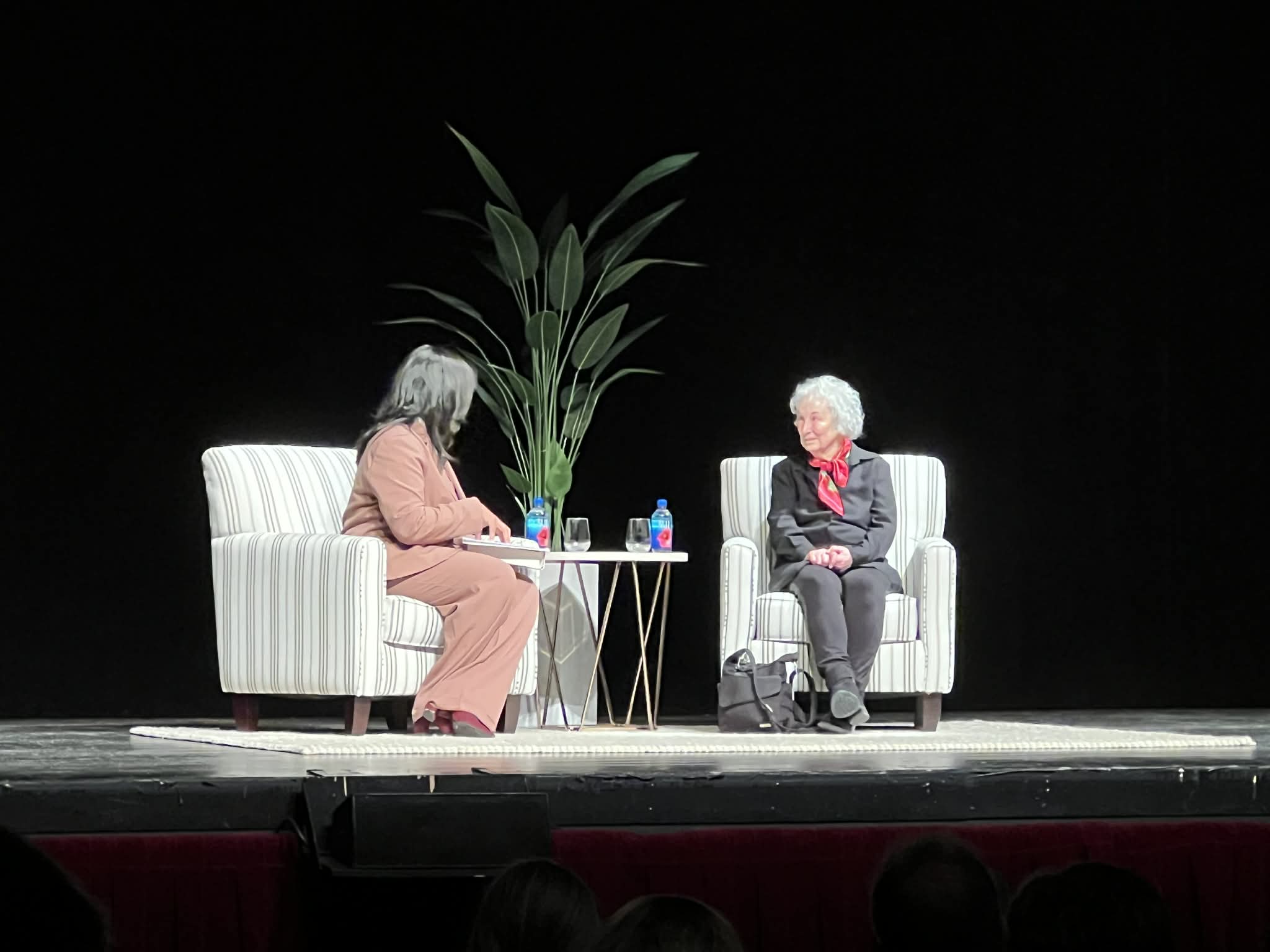
In Conversation: An Evening with Margaret Atwood
Detroit Opera House
1526 Broadway St.
Detroit
Jan. 26, 2026
Margaret Atwood is really funny. The renowned author, famed for The Handmaid’s Tale, sat down with close friend and Detroiter Sam White – founder of Shakespeare in Detroit – for a conversation about her life and career during “In Conversation: An Evening With Margaret Atwood.” The event drew an enthusiastic crowd from across Metro Detroit and beyond to pack the Detroit Opera House. It followed the November release of her new memoir, Book of Lives: A Memoir of Sorts, and came ahead of Detroit Opera’s March production of The Handmaid’s Tale.
The approximately hour-long conversation covered topics that ranged from karma to opera to politics, incorporating some bird-watching tips for good measure – all delivered with rapid quips and an obvious warmth and comfort between the old friends.
One of the topics I found most interesting about the evening was Atwood’s take on karma. She said she's struggled with holding grudges “but not very much,” as she believes in energy re-balancing itself. Regarding revenge, she hesitated when asked if it's better to get even or to live your best life, saying they were both worthwhile, and that you don’t need to grant people forgiveness who don’t ask for it. On a more positive note, she recommended reading Lewis Hyde’s The Gift, which is about the gift economy and the importance of passing along one's gifts to others, as opposed to monetary transactions.
I’m not sure I entirely agree about holding onto grudges – which I also like to do. But I admire Atwood's confidence in pushing back on the idea of letting go of wrongdoings, especially coming from an octogenarian who has significantly more life experience than most of us.
Another takeaway I enjoyed was when Atwood discussed how she reconciled understanding her authentic self with images projected upon her by others. She said she accepts that not every work will resonate with everyone, something young writers should take note of. She compared it to throwing a message in a bottle into the ocean; it might sink and vanish forever, or it might wash ashore where someone could find it, but not be able to read it, or read it and not like it, or read it and feel the message is for them.
She talked briefly about the upcoming opera, recalling her first meeting with Danish composer Poul Ruders, who knelt at her feet begging her permission to allow him to compose an opera adaptation of The Handmaid’s Tale. He said it would be the first commission by the Danish Royal Opera in 34 years, and it had to be The Handmaid’s Tale or nothing. While she thought he was crazy, she figured it would either be good and a new venue for artists to create, or would be bad, and disappear altogether, so said yes.
While politics didn’t dominate the conversation, the issues and stress of the current Trump administration came up throughout the evening, especially relevant to a crowd made up largely of left-leaning women. Atwood said she doesn’t think the downward trajectory of the United States is good for the world, and to really make America great again, we need to return to the democratic values the United States used to stand for.
Some of the more amusing moments from the evening included Atwood sharing her decades-long struggle with her unruly, curly hair and discovering a rumor about herself that she would wander the streets of Toronto at night dressed in 18th-century French court dress. She also said her dream cameo would be to play Ruth Zardo, a crotchety poet character from Louise Penny’s Chief Inspector Armand Gamache murder mysteries.
Atwood also read an excerpt from The Handmaid’s Tale, a selection from Chapter 19 in which main character Offred is struggling to keep her sanity. Atwood said upon a recent re-read of the book, she thought “This is really creepy,” which drew (one of the many) laughs from the crowd.
She recalled some of the inspirations from names and titles used in The Handmaid’s Tale, which was first published in 1985. She said she took the word “salvaging” – the name of the executions held in the fictional dystopia of Gilead – from the public execution “salvagings” occurring during the Ferdinand Marcos dictatorship in the Philippines at the time. On a lighter note, she said the names of the Aunts in the book were inspired by names associated with women-centered products, including Lydia Pinkham, who created medicinal remedies for women in the 19th century, cosmetic founders Elizabeth Arden and Helena Rubinstein, and the dessert brand Sara Lee.
The whole experience was engaging, enlightening and entertaining. In a time when people worry that Atwood’s fictional dystopia is turning into real life, the tone was more hopeful than dire. It was clear the audience left the event even more endeared to her than when they arrived, including me.


